Where it fits
- Review EIBOS documentation for operating and loading details.
- 1 temperature zone; material compatibility still depends on the selected setting.
Use the documented range as a screening constraint, not a universal setting. Match the exact filament procedure, carrier reel, load, timer, and feed path before choosing this model.
Tradeoffs and checks
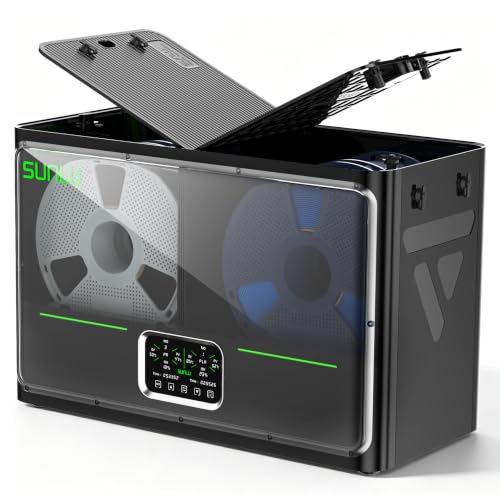
Current official store conflicts internally: title and Data Sheet say up to 70°C, lower Tech Specs says ≤80°C. Manufacturer introduction/catalog also says 70°C. No explicit 80°C variant selector was established. Keep current-variant ceiling unknown or label conservative historical 70°C; do not promote as an 80°C upgrade without verification. Current store supports two spools each 217 ×80mm. Lower table has conflicting single-spool widths 174/170mm and apparent copied rotation/extension specifications; omit those details. Data Sheet requires changing Teflon tubing for 2.85mm filament.
If a reel dimension is not established, measure the complete loaded reel and confirm it with the manufacturer or seller. Multi-spool fit can depend on loading arrangement.
Before your first session
Read the equipment instructions and exact material datasheet together. Check power compatibility, placement, clearances, reel limits, and the complete temperature-and-time pair. Record the material, selected setting, duration, and repeat-print result without changing other variables.
A chamber or container sensor reports nearby air conditions; it does not directly measure water inside every layer of wound filament.
Research and sources
These buying notes by John Morris were reviewed September 16, 2026. We have not independently measured temperature uniformity, noise, seal performance, or drying results.