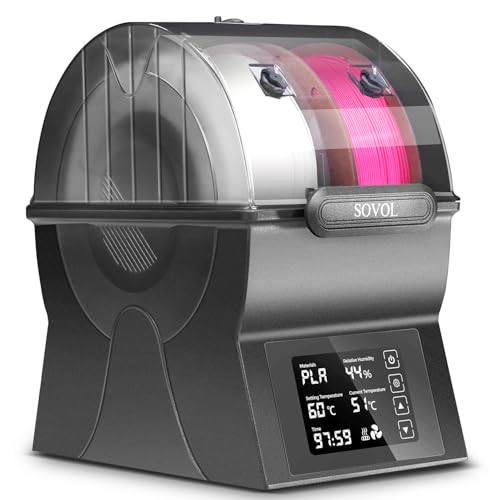
PETG does not have one safe drying temperature or duration for every brand and grade. Decide whether a cycle is useful from the exact product instructions, storage exposure, and a repeatable print result. Then pair the manufacturer’s temperature and time, verify the reel and dryer, and keep printer tuning separate from the drying comparison.
Does PETG need drying before every print?
Not automatically. Start with the complete product label and its manufacturer’s current instructions. If a protected spool still produces a repeatable good print and its maker does not require preparation before use, an automatic cycle has no demonstrated benefit. If an opened spool has changed from a known-good result or its maker calls for drying after moisture exposure, a controlled comparison is more useful.
Record the opening date, whether the spool returned to sealed storage with suitable desiccant, and whether the room or season changed. Storage history cannot measure moisture inside the filament, but it helps you decide whether to test drying or investigate the printer first.
Compare the exact PETG brand and grade
Copy the brand, full product name, grade, modifiers, diameter, and reel or refill type. Standard, high-flow, reinforced, recycled, and modified copolyester products should not inherit one another’s settings merely because every label includes PETG.
Two current manufacturer examples show the boundary. Prusa lists Prusament PETG at 55°C for six hours. Polymaker’s PolyMax PETG page lists 65°C for six hours in its Print Settings, but the same page’s technical summary says four hours. The Prusament pair is usable for the named family after checking its reel; the conflicting PolyMax duration should remain excluded from presets until Polymaker resolves it.
- Prusament PETG: 55°C for six hours in Prusa’s current drying table.
- PolyMax PETG: 65°C is repeated, but the same official page conflicts between six and four hours.
- Other PETG products: unknown until their own current instructions establish a temperature, duration, method, and condition.
Can I dry PETG at 45 degrees?
Do not use 45°C as a universal PETG answer. It is below Prusa’s published 55°C value for Prusament PETG, and the official source does not say that a longer 45°C cycle is an equivalent substitute. A dryer reaching 45°C may therefore fail the documented requirement for that named product even though it produces warm air.
A different PETG maker may specify a different process. Use its exact value rather than transferring Prusament’s pair or improvising a longer low-temperature cycle. If the filament source, reel limit, and dryer instructions cannot be reconciled, pause and obtain clarification instead of guessing.
Keep temperature and time paired
Temperature and duration describe one process together. Do not keep one manufacturer’s time while borrowing another grade’s temperature, and do not average conflicting instructions. Note whether the guidance is unconditional, required before printing, or applies only after moisture exposure.
A chamber humidity display is not an endpoint for the filament itself. It measures air near the sensor, not water inside every layer of the spool. Follow the supported pair and method, then use a consistent print comparison to decide whether the practical result changed.
Check the machine and spool together
Compare the required pair with the dryer’s supported range, operating mode, ventilation, and loading instructions. Confirm that the carrier reel and any adapter tolerate the selected conditions. Prusa distinguishes redesigned spools introduced from October 2025 from older black reels that can loosen above 45°C unless their documented preparation is followed.
If drying two PETG spools together, verify both independently. Two colors with the same material label may come from different grades, reels, or manufacturers. Group them only when every supported instruction agrees on the common process; otherwise prepare them separately and keep their histories distinct.
As an Amazon Associate, we earn from qualifying purchases. Buying through our links may earn us a commission.
Comparing equipment? Review the documented limits before buying.
View SUNLU S2 on Amazon ↗A relevant option to investigate, not a diagnosis or a universal recommendation.
Use a PETG print-outcome checklist
Save a small model that exposes the symptom you want to address. Keep the file, slicer profile, printer, nozzle, and room conditions fixed. Photograph the baseline, run only the supported drying procedure, and repeat the same print before changing retraction, nozzle temperature, speed, cooling, or hardware.
Record whether stringing, surface quality, extrusion consistency, or another chosen symptom improved, stayed the same, or became worse. Describe the observation rather than declaring the spool permanently dry. One comparable result is evidence about this process and setup, not every PETG formulation.
What if PETG still strings after drying?
Persistent stringing does not prove the drying cycle failed. Prusa’s PETG guide identifies PETG as naturally prone to stringing and discusses retraction, nozzle temperature, and cooling as print variables. If the supported cycle made no measurable difference, move to those diagnostics one at a time instead of extending the cycle or raising its temperature.
Also inspect the feed path, nozzle condition, material profile, and whether the before-and-after print was truly comparable. If the result worsens or the reel deforms, stop and recheck the filament, reel, and dryer instructions before another cycle.
Preserve the preparation between projects
Return the spool to appropriate sealed storage when it is not feeding the printer. Maintain the container and desiccant according to their instructions, then record any prolonged exposure or changed print behavior. A clear location and recent result are more informative than an unsupported label saying permanently dry.
Keep one compact record containing the exact PETG product, source URL, paired procedure, reel, dryer, and comparison result. Update it when you change brands, grades, reels, or methods. That turns drying into a repeatable workflow and prevents the next unrelated slicer or hardware problem from being treated as proof of moisture.
Sources and research notes
This guide synthesizes published guidance. It does not describe our own laboratory or hands-on product testing. Material instructions apply to the named manufacturer and grade.