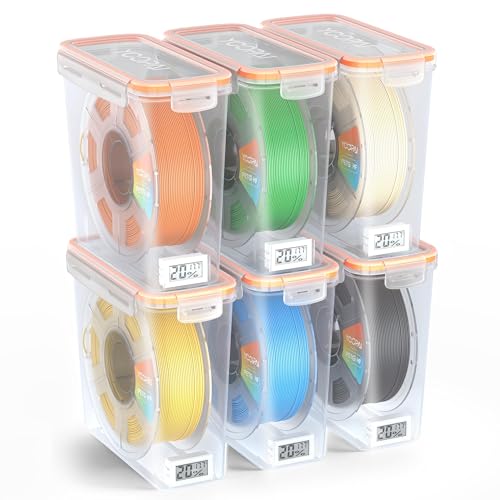
Store an already-prepared spool in a closed container or intact storage bag that fits the loaded reel, use compatible desiccant as its maker directs, label the exact material, and minimize time open. A passive box or bag slows renewed moisture exposure; it does not dry filament that has already absorbed moisture. Build the return step into every print so the system works after the first week.
Choosing a format? Compare verified options in the storage collection. Building instead? Use the DIY cereal-container fit and seal guide. Organizing several protected spools? Plan the rack, shelf, or cabinet around sealed units. Then check passive storage versus active drying, follow the desiccant guide, and keep each spool's location and preparation history in the private spool studio.
Use one opening-to-storage routine
Before opening a spool, copy the manufacturer, full product and grade from the label and read its current preparation and storage instructions. Decide whether the spool is ready to print, needs a supported drying cycle, or should remain sealed. Storage preserves a known condition; it cannot establish that an unknown or troublesome spool is dry.
Give the spool a destination before printing. Retrieve only the material needed for the job, keep other containers closed, and return unused filament promptly after unloading by the printer's procedure. Prusa's storage guidance supports closed boxes with desiccant or vacuum bags with desiccant, while its passive USS Drybox instructions explicitly say that the box does not dry already-moist filament.
- Open: identify the exact filament and retrieve only the spool needed.
- Prepare: follow a supported drying procedure when the material requires one.
- Print: keep other stored spools closed and protect the loose filament end.
- Return: close the box or bag, update the location, and record anything that changed.
Choose a box, bag, or feed-through setup by use
Use a rigid box when you expect frequent access, want the label visible, or need a documented feed-through arrangement. Use an intact storage bag when individually sealing less frequently accessed spools matters more than printing from the enclosure. An open rack or shelf organizes protected spools but is not itself a moisture barrier. A feed-through box adds moving parts and a filament route, so verify the outlet, tube, reel rotation, and normal printer loading path instead of treating it as an ordinary sealed container.
A product family may sell storage boxes separately from its active drying hardware. Polymaker's PolyDryer, for example, uses detachable boxes with a separate Dry Dock. Confirm the exact bundle before ordering. A box-only listing is useful storage equipment, not proof that a heater or drying cycle is included.
Check fit, seals, valves, and unused openings
Measure the loaded reel's diameter and width with any carrier or adapter that will remain installed. Confirm usable interior space rather than relying on nominal filament weight or a container's outside dimensions. The lid must close without touching the reel, pinching the bag seal, or forcing a marginal feed path.
Inspect the closure before blaming the desiccant. Prusa's USS instructions tell owners to inspect seals, close access caps, and seal an unused filament guide; apply those checks to that exact model and use the equivalent instructions for another box. For bags, inspect the closure, valve, seams, and punctures. No current evidence supports one universal leak rate or storage lifetime for every catalog product.
Interpret humidity as an air reading—not a filament test
A hygrometer reports the air near its sensor. It does not directly measure water inside the wound filament. Relative humidity also changes with temperature, so compare readings only with the box in a similar location and operating state. After closing a container, allow the sensor the stabilization time stated by its maker; Prusa says the USS reading may take up to one hour to stabilize.
Check the instrument's range and accuracy before treating a target as verified. Prusa lists a below-10% ideal for ASA in its USS instructions, while the included TPM40 display starts at 10% RH and is rated at ±3% RH. That display therefore cannot establish that a below-10% value has been reached. This is an instrument boundary, not a universal ASA target or proof about moisture inside the spool.
As an Amazon Associate, we earn from qualifying purchases. Buying through our links may earn us a commission.
Comparing equipment? Review the documented limits before buying.
View Polymaker PolyDryer Box on Amazon ↗A relevant option to investigate, not a diagnosis or a universal recommendation.
Label the spool and keep histories separate
Record the brand, complete product and grade, color, opening date, storage location, and a short spool code. Keep the source for its preparation instructions with the record. Mark low remaining quantities and separate questionable spools from ready-to-use material so a later print comparison does not silently switch to another spool.
Store three facts separately: where the spool is, what supported drying process it last completed, and when the enclosure's desiccant was serviced. None of those entries proves current internal moisture content, but together they reveal a broken handoff, a repeatedly opened box, or a maintenance step that was missed. Avoid labels such as 'always dry,' 'safe forever,' or a universal expiry date.
Decide whether to maintain storage or dry the spool
If an air reading rises, inspect the closure, unused ports, sensor conditions, and exact desiccant instructions before assuming the filament needs heat. Maintain or replace only the desiccant product as its maker permits; indicator colors and regeneration procedures do not transfer automatically between packets, beads, or cartridges.
If the exact material instructions require drying, exposure history is unknown, or a controlled print comparison supports that next step, move to a compatible active-drying procedure. Afterward, return the prepared spool to suitable storage. If a supported cycle does not change the print symptom, investigate printer settings and feed resistance rather than escalating temperature or declaring the container defective.
Sources and research notes
This guide synthesizes published guidance. It does not describe our own laboratory or hands-on product testing. Material instructions apply to the named manufacturer and grade.