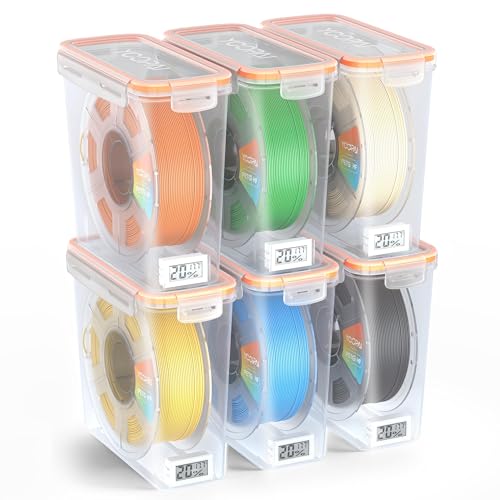
A rack or shelf organizes spools; it does not protect exposed filament from moisture. Treat the moisture barrier as a separate item around each spool or group of spools, then size the furniture for those loaded boxes or bags. An ordinary cabinet is still ordinary furniture unless its maker documents a sealed or controlled storage function. This guide turns those boundaries into a practical layout, labeling, fit, and return routine without inventing shelf load ratings or universal humidity targets.
Start with the filament storage routine, measure the actual reel with the spool-size worksheet, and use the desiccant guide only for a defined enclosure. Compare documented boxes and bags in the storage collection.
Choose the moisture barrier before the furniture
Start with the unit that will actually protect the filament: an intact storage bag, a closed box, or another enclosure documented for the exact setup. Prusa recommends closed boxes with desiccant or vacuum bags with desiccant for storage. Its USS Drybox documentation also makes the limit explicit: a passive box slows moisture absorption but does not dry filament that is already moist.
A rack, shelf, cart, or ordinary cabinet sits outside that protection layer. It can make spools visible and easier to retrieve, but open air still reaches a bare reel. Do not call an open rack dry storage, and do not assume a cabinet door creates an airtight seal. Prepare a questionable spool with a supported drying procedure first, then return it to the chosen protective enclosure.
- Organization layer: rack, shelf, cart, or cabinet that holds the protected units.
- Moisture layer: the intact bag or closed container around each spool or defined group.
- Preparation layer: a separate supported drying process when the exact material requires one.
- Record layer: spool identity, condition, location, and the source for any preparation procedure.
Measure the protected unit, not a bare nominal spool
Measure the actual box or bag after it contains the loaded reel, desiccant holder, label, valve, and anything else that remains in storage. Record the maximum width, depth, and height, including latches, handles, hinges, feet, and tubing that cannot be removed. A one-kilogram filament label does not define the outside size of either the reel or its protective enclosure.
Then measure the clear shelf opening and the route into it. Leave enough access to close every latch, inspect the bag closure, read the spool code, and remove one unit without dragging adjacent containers forward. Do not infer usable capacity from a product photograph or divide a cabinet width by an assumed spool diameter. The standard PolyDryer Box, for example, publishes a 205 mm by 78 mm reel envelope; that named limit does not transfer to another box, a bag, or a shelf cell.
- Protected unit: loaded outside dimensions, latch and handle projections, and required orientation.
- Shelf opening: clear width, depth, height, door swing, lip, brace, and any rear obstruction.
- Handling path: space to lift or slide one unit without disturbing another seal or feed tube.
- Unknown dimensions: mark unresolved and measure the exact hardware before assigning a slot.
Give every slot one condition and one destination
Separate at least three conditions in the layout: prepared and ready to use, returned after a print, and needs review or supported drying. A location label can state what workflow should happen next, but it is not proof of internal moisture condition. Keep the exact brand, product, grade, color, spool code, and opening date on the container record rather than relying on color or position alone.
Use stable slot names such as Cabinet A / Shelf 2 / Position 4 and keep the label visible from the aisle. When a spool moves, update its location instead of creating a second record. Keep an unknown or troublesome spool out of the ready zone until its identity and next step are resolved; this prevents a convenient shelf position from silently becoming a quality claim.
Use open racks and shelves only for protected spools
An open rack is useful when quick visual inventory and individual retrieval matter. It is a poor substitute for a moisture barrier. Store each spool in its closed bag or box, keep valves and closures accessible, and avoid a layout that requires leaving lids ajar or feed ports open. If a spool must stay connected to a printer, use a documented feed-through enclosure rather than exposing the entire shelf.
Follow the rack or shelving manufacturer's assembly, anchoring, placement, and load instructions for the exact model. Filament mass, boxes, hardware, and any printer above or below all contribute to the real load. This guide provides no shelf capacity, stacking limit, wall fastener, or span calculation; do not estimate one from the number of spools shown in a photo. If the maker does not provide the required limit or mounting method, choose equipment with usable documentation.
As an Amazon Associate, we earn from qualifying purchases. Buying through our links may earn us a commission.
Comparing equipment? Review the documented limits before buying.
View Polymaker PolyDryer Box on Amazon ↗A relevant option to investigate, not a diagnosis or a universal recommendation.
Distinguish an ordinary cabinet from controlled storage
A closed door can hide clutter and reduce dust, but it does not establish a gasket, leak rate, desiccant system, dehumidifier performance, or humidity range. Unless the exact cabinet documentation supports a sealed or controlled-storage role, keep using individual bags or boxes inside it. Treat door gaps, cable openings, vents, and frequently opened drawers as ordinary room exposure, not as evidence that the cabinet failed a dry-storage promise it never made.
A documented dry cabinet or dehumidifying cabinet is a different equipment class. Verify its stated operating range, sensor location and accuracy, recovery behavior after opening, usable internal dimensions, permitted load, maintenance, and electrical instructions. Do not transfer a setpoint from another cabinet or interpret its air reading as a direct measurement of water inside filament. If current first-party evidence for a model is incomplete, leave that purchasing decision unresolved rather than turning the generic cabinet query into an unsupported product recommendation.
Keep openings, sensors, and desiccant local to one enclosure
Service the smallest enclosure that actually changed. If one box was opened, inspect that box's closure, unused ports, spool position, and desiccant instructions before disturbing every container on the shelf. Polymaker's modular architecture illustrates the separation: each Box can be used for storage, while the separate Dry Dock supplies the active function. A shared rack does not merge those boxes into one controlled chamber.
A hygrometer reports air near its sensor, not moisture inside each reel. Keep the reading with its enclosure, temperature, and stabilization time, and apply only the device maker's range and accuracy. Do not average unrelated box readings, use one exposed room sensor as proof that every sealed spool is protected, or promote one percentage to a universal threshold. Regenerate or replace desiccant only by the exact product instructions.
Commission the layout before filling every slot
Begin with a small representative set: the largest protected unit, the heaviest documented configuration, a frequently used spool, and one item that needs review. Assemble and place the furniture by its maker's instructions. Confirm that doors, latches, bags, labels, and feed paths remain usable, then retrieve and return each unit through the normal work area without forcing a fit or disturbing an adjacent closure.
Record the slot map and the evidence still missing. Reject a layout if a box must be stored open, a bag valve is crushed, a reel identity disappears from view, a documented load or mounting requirement cannot be met, or normal retrieval threatens another container's seal. Recheck the layout after changing container size, adding a refill carrier, moving the furniture, or installing a printer or other equipment on the same structure.
- Can every protected unit close fully in its assigned orientation?
- Can one unit be retrieved without opening or moving the others?
- Is the spool identity and next workflow step visible before the container is opened?
- Are furniture load, assembly, anchoring, and placement requirements documented and followed?
- Are cabinet controls, sensors, maintenance, and electrical limits tied to the exact model?
Sources and research notes
This guide synthesizes published guidance. It does not describe our own laboratory or hands-on product testing. Storage-function examples apply only to the named enclosure; follow the exact furniture and cabinet instructions for structure, load, mounting, controls, and maintenance.