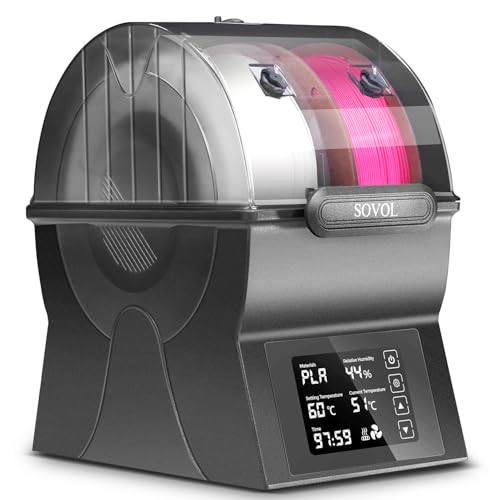
TPU often needs closer moisture control than PLA, but the correct response still depends on the exact product, its exposure, and the manufacturer’s instructions. Identify the grade before choosing a temperature-and-time pair. Then verify the reel, dryer, tubing, feeder, and printer separately: a dryer that reaches the required temperature is not automatically a compatible TPU feeding system.
Does TPU filament need to be dried?
Sometimes—and some TPU products require or recommend it before use—but do not start every spool on an automatic cycle. Prusa identifies TPU (Flex) among the materials more often in need of drying than PLA. That establishes moisture sensitivity as a serious possibility, not proof that moisture caused a particular defect.
Check the exact product instructions, how long the spool was exposed, and whether a controlled before-and-after print changes the symptom. Surface defects, bubbling, stringing, or inconsistent extrusion can justify investigation, but flexible-filament feeding and profile problems can produce overlapping symptoms. A sealed package also does not replace the maker’s preparation instructions.
Compare complete temperature-and-time pairs
Prusa’s current table for its named material guidance lists TPU at 60°C for four to six hours. Polymaker’s PolyFlex TPU95 Print Settings instead specify 65°C for eight hours only if that material has absorbed moisture. These are two supported examples, not values to average and not a universal 60–65°C range for every flexible filament.
Write down brand, complete product name, hardness, diameter, modifiers such as high flow, the source URL, temperature, duration, and any condition attached to the instruction. Hardness describes part of the material’s behavior; it does not supply a drying recipe. When the label and current manufacturer page disagree, stop and ask the maker rather than combining the easier values.
Match the dryer and carrier reel
The dryer must support the complete pair, not just reach the target temperature for a moment. Check its operating mode, timer, loading arrangement, airflow instructions, and whether the manufacturer permits feeding during the selected mode. A front-panel TPU preset does not resolve a mismatch with the filament maker’s procedure.
Measure the loaded reel’s outside diameter and widest point, then verify the carrier’s heat tolerance. Prusa distinguishes newer and older spool constructions because older black spool sides can loosen above 45°C without its documented preparation. Confirm the exact spool rather than assuming that the filament can tolerate whatever the reel cannot.
Treat TPU feeding as a separate compatibility test
A temperature match in the Dryer Finder means the machine meets the documented heat and capacity requirements entered; it does not certify TPU feeding. A spool can fit the chamber while the outlet, tube route, feeder, or printer adds too much resistance for a flexible strand. Verify every part of the intended route with the exact equipment instructions.
Polymaker highly recommends direct drive for PolyFlex TPU95 and warns that large gaps between the extruder and hot end can cause printing issues. That is product-specific feeding guidance, not a rule that every direct-drive printer accepts every TPU. Integrated material systems may have their own restrictions even when their dryer can heat the spool.
- Confirm that the dryer supports the intended outlet and printing mode.
- Check the printer or feeder manual for the exact TPU grade or hardness.
- Use the shortest supported route without sharp bends or pinched tubing.
- Verify free spool rotation with the normal lid, rollers, adapters, and outlet.
- Treat an unknown feed specification as unconfirmed—not a match.
As an Amazon Associate, we earn from qualifying purchases. Buying through our links may earn us a commission.
Comparing equipment? Review the documented limits before buying.
View SUNLU S2 on Amazon ↗A relevant option to investigate, not a diagnosis or a universal recommendation.
Separate moisture symptoms from feed resistance
First ask when the problem begins. A rough or bubbly extrusion pattern that changes after the supported preparation can point toward moisture management. Clicking, buckling, inconsistent loading, or a problem that appears only after adding a tube or dryer belongs on the feed-path branch. Neither observation alone proves the final cause.
Keep one branch stable while checking the other. When evaluating moisture, preserve the printer, profile, route, and test object. When evaluating feeding, use consistently prepared filament and change one supported part of the route at a time. If the issue exists before the material enters the dryer or returns when the dryer is bypassed, record that result rather than extending the heat cycle.
Run a controlled TPU validation print
Use a short model suited to the flexible material and preserve the project file. Record the exact spool, preparation, dryer, route, printer, profile, room conditions, and chosen observation. Complete any required pre-drying before the filament that enters the nozzle is used as the comparison; warming and printing at the same moment is not equivalent to a completed preparation cycle.
Avoid changing drying temperature, duration, flow, speed, retraction, and hardware together. Record whether the chosen symptom improved, stayed the same, or became worse. If the supported cycle makes no measurable difference, move to the printer and feed-path diagnostics instead of assuming that a hotter or longer cycle is the answer.
Protect TPU during the job and after use
If the exact material calls for protection during printing, confirm that the dryer or dry box supports the intended feed mode for the entire job. A machine timer ending early, a shared chamber set for another material, or a restricted automatic feeder can break an otherwise sound plan. Resolve those limits before starting a long print.
After use, follow the exact product’s storage guidance and record where the spool went. Bambu’s TPU85A and TPU90A guide, for example, emphasizes prompt sealed storage with effective desiccant; that instruction remains specific to those products. Reliable TPU handling joins three documented decisions: the material process, the feed route, and the storage handoff.
Sources and research notes
This guide synthesizes published guidance. It does not describe our own laboratory or hands-on product testing. Material instructions apply to the named manufacturer and grade.