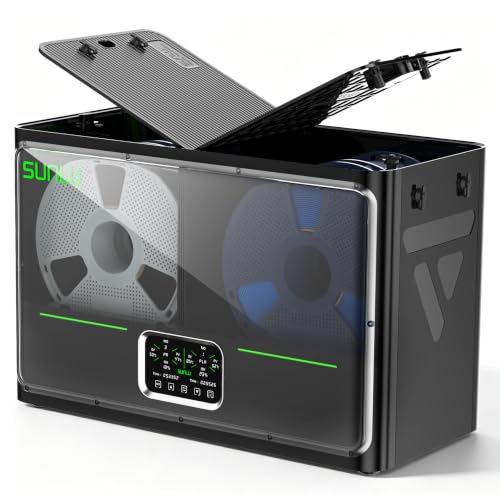
Choose the SUNLU S2 when preparing one active spool fits your routine. Consider the original S4 when several compatible spools regularly need preparation together. Both sit in the 70°C maximum class, so this is primarily a capacity and workflow decision. The S4 Pro is a separate product and should not be substituted in this comparison.
The central difference is useful capacity
The S2 is a single-spool dryer; SUNLU describes the original S4 as accommodating four one-kilogram rolls. That does not mean the larger unit prepares an individual spool four times faster. It means you can organize several compatible jobs together instead of scheduling each spool separately.
List the materials needed for your next three projects. If those projects use one spool at a time and you rarely change materials, the S2 matches that pattern directly. If a project regularly needs several prepared colors, the S4’s extra positions have a clear purpose. Count actual simultaneous demand before counting the number of spools on your shelf.
More positions do not provide separate temperatures
Both models have a manufacturer-stated maximum of 70°C. The original S4 uses one temperature setting for its shared chamber. It does not provide the independent zones associated with the separate S4 Pro model. Group a load only when all included filament products and spools support the selected process.
If one material needs a substantially different preparation cycle, plan separate runs or compare independently controlled equipment. A larger shared chamber does not remove that conflict. Likewise, neither model’s material labels override a filament manufacturer’s instruction that exceeds the machine’s supported range.
Check fit and the exact S2 revision
SUNLU’s S2 documentation identifies a spool envelope of 210mm diameter by 85mm width. Confirm the exact spool, including any fitted adapter, instead of relying on its nominal weight. For the S4, obtain the intended multi-spool layout from the manual; total chamber dimensions are not individual-spool clearance limits.
The current S2 product page describes a bottom fan alongside upper and lower heating pads. Check that the listing and delivered revision match the version you intend to buy. A comparison becomes unreliable when an older listing silently supplies a different configuration from the specification being discussed.
As an Amazon Associate, we earn from qualifying purchases. Buying through our links may earn us a commission.
Comparing equipment? Review the documented limits before buying.
View SUNLU S2 on Amazon ↗A relevant option to investigate, not a diagnosis or a universal recommendation.
Plan every feeding route before installation
SUNLU supports printing while drying on both models, and the S4 provides multiple outlets for multi-spool arrangements. Decide which printer or feed system each outlet will serve. Place the dryer where the intended route remains accessible without tubes crossing moving parts or obstructing lid access.
Draw the routes for the busiest job you actually run. A four-spool box can consolidate material preparation, but it also concentrates several paths in one location. Confirm loading and spool rotation with a short supported print before relying on the arrangement for a complex project. Complete required pre-drying before feeding a wet material.
Which would make your next project easier?
The S2 is the straightforward shortlist option when one compatible spool is the normal workload. Pair it with suitable storage for other colors instead of treating every spare spool as active capacity. The S4 becomes more persuasive when shared preparation genuinely reduces repeated handling or waiting between jobs.
Before choosing, confirm the model revision, regional power configuration, spool layout, included tubes, and operating instructions. This comparison evaluates documented features and their practical implications; it does not report measured drying speed, noise, or energy use. Choose the workflow you can describe and regularly use, rather than interpreting the larger number in a model name as an automatic upgrade.
Sources and research notes
This guide synthesizes published guidance. It does not describe our own laboratory or hands-on product testing. Material instructions apply to the named manufacturer and grade.