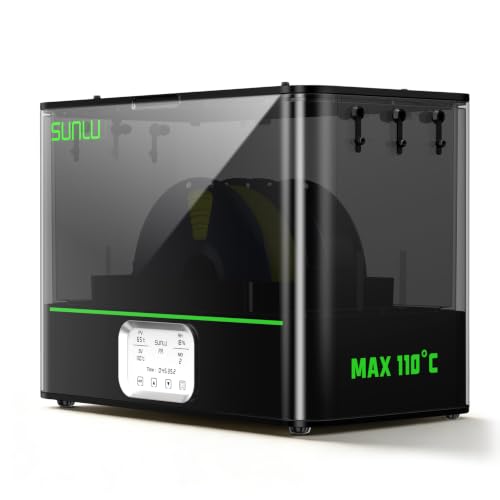
Where it fits
- Insulated heated chamber; filament feed tubes supplied.
- 1 temperature zone; material compatibility still depends on the selected setting.
Use the documented range as a screening constraint, not a universal setting. Match the exact filament procedure, carrier reel, load, timer, and feed path before choosing this model.
Tradeoffs and checks
At ≥80°C, humidity sensor enters protection and displays <10% RH; this is not proof of filament dryness. Maker says accuracy recovers about 20 hours after cooling to 70°C. Official wiki and current product page disagree on chamber dimensions/capacity. Use exact product/revision dimensions. Both spool and filament must tolerate selected heat. Annealing is separate from drying.
If a reel dimension is not established, measure the complete loaded reel and confirm it with the manufacturer or seller. Multi-spool fit can depend on loading arrangement.
Before your first session
Read the equipment instructions and exact material datasheet together. Check power compatibility, placement, clearances, reel limits, and the complete temperature-and-time pair. Record the material, selected setting, duration, and repeat-print result without changing other variables.
A chamber or container sensor reports nearby air conditions; it does not directly measure water inside every layer of wound filament.
Research and sources
These buying notes by John Morris were reviewed September 16, 2026. We have not independently measured temperature uniformity, noise, seal performance, or drying results.


