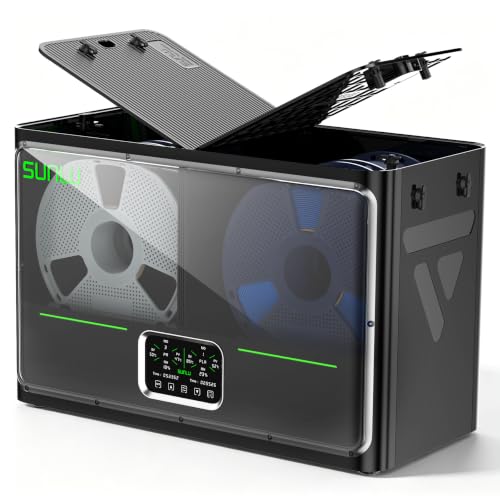
SUNLU / DRYING
SUNLU S4 Pro
Two independently controlled chambers let four spools share a station while using different drying settings.
4 spoolsUp to 85°C
Check on Amazon Details & tradeoffsTHE RIGHT EQUIPMENT FOR THE JOB
Compare verified dryer ranges against an exact engineering-filament process, reel limit, load, and operating mode.
Check my requirements ↗CHECK / 01
Start with the named filament grade and its complete temperature-and-time instruction. ASA, ABS, nylon, and filled composites do not share a universal preset.CHECK / 02
Treat 70°C, 80°C, 85°C, 90°C, and 100°C as distinct capability gates. A generic compatibility label cannot make up a numeric shortfall.CHECK / 03
Verify the carrier reel, timer, load, airflow, and operating instructions. A stated chamber maximum is capability—not the setting for every spool.As an Amazon Associate, we earn from qualifying purchases. Buying through our links may earn us a commission.
SUNLU / DRYING
Two independently controlled chambers let four spools share a station while using different drying settings.
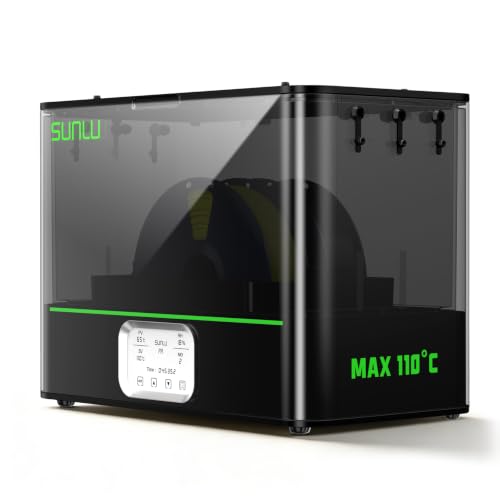
SUNLU / DRYING
A higher-temperature dryer reaching 110°C for named engineering grades whose datasheets call for more heat.
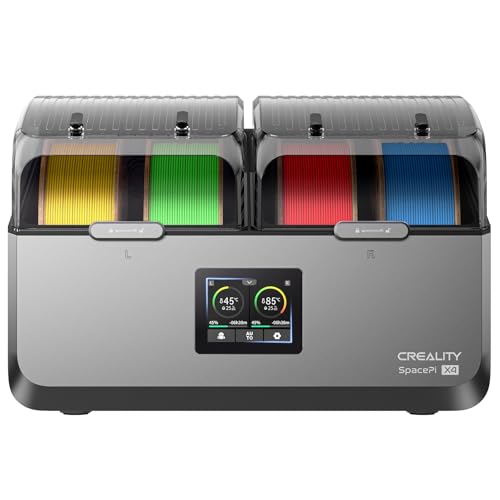
Creality / DRYING
A four-spool station with two independent heated chambers, active exhaust, and an 85°C ceiling.

EIBOS / DRYING
A two-spool rotating dryer in the verified 80°C temperature variant, with humidity control and adjustable exhaust.

Comgrow / DRYING
Four-spool capacity in two independent chambers, with a 45–85°C range and automatic vents.
The best fit is the model that clears the exact filament process without leaving the reel, timer, load, or operating mode unresolved. Do not rank dryers by maximum temperature alone. Start with the named grade, then remove every product whose documented range stops below the required temperature.
Exact examples were rechecked against Prusa's drying and spool guidance ↗ and Polymaker's Fiberon PA6-CF20 page ↗.
A 70°C dryer can clear the temperature requirement in Polymaker's named PolyLite ABS example: 70°C for six hours after moisture absorption. It does not reach Prusa's 80°C, four-hour procedure for Prusament ASA. Those are product-level examples, not universal ABS and ASA settings, and a longer guessed 70°C cycle is not a supported substitute for the 80°C instruction.
Polymaker's current ASA page and technical data sheet disagree between six and seven hours at 70°C, so that grade remains excluded from the selectable reference until the conflict is resolved. Read the ASA and ABS drying guide for the source comparison, reel limits, and the checks that remain after a model clears the temperature gate.
Read the nylon grade and dryer-limit guide before comparing products. The manufacturer drying reference preserves exact grade examples, and the Dryer Finder screens the documented temperature, capacity, and reel dimensions you enter.
Among the documented options shown here, a 70°C ceiling cannot satisfy an 80°C process, and an 80°C or 85°C ceiling cannot satisfy a 90°C or 100°C process. Only keep a lower-temperature model when the exact material instruction stays within its range.
After the temperature gate, verify timer length, carrier reel, capacity, and operating mode. A higher chamber ceiling still does not authorize that setting for a different grade.
Open the product details and review the limitations, then check the current retailer listing for the exact revision, included parts, seller, and return terms. Specifications here come from published sources, not independent performance measurements. Where a dimension or capability could not be established, it stays unknown.
Our Finder separates documented temperature and capacity matches from products that require more verification. It does not certify safety or diagnose a printer. If moisture symptoms continue after following the maker’s drying procedure, investigate print settings and feed resistance as separate variables.
How we compare products · Manufacturer drying reference · All collections