Nylon is a material family, not one dryer setting. PA6, PA12, PA11, blends, and carbon- or glass-filled grades can require different preparation. Identify the full product, keep its documented temperature and time together, verify the reel, and then choose equipment that can support the complete process. A generic nylon-compatible label does not settle any of those checks.
Does nylon filament need to be dried?
Nylon products are commonly moisture-sensitive, but the correct action still comes from the exact grade and its current instructions. Prusa says polyamide is affected significantly by humidity and recommends dry storage or drying before every print for highly hygroscopic materials. That supports a careful routine; it does not create one universal nylon temperature.
Start by recording the manufacturer, complete product name, PA type, diameter, spool or refill, and every modifier such as CF or GF. PA6-CF20 and PA11 Carbon Fiber are not interchangeable labels. Keep the current technical sheet, product page, safety information, and preparation instructions with the spool record so a later cycle can be traced to a named source.
How hot and how long should nylon dry?
There is no responsible family-wide answer. Two current manufacturer examples show the spread: Prusa specifies 90°C for six hours for Prusament PA11 Carbon Fiber, while Polymaker lists 100°C for eight hours for Fiberon PA6-CF20 only when that material has absorbed moisture. Each pair belongs to that named product and source.
Do not separate the number that is convenient from the rest of the instruction. A dryer capped at 80°C or 85°C does not meet a documented 90°C or 100°C process merely because a listing mentions nylon. Likewise, do not invent a longer low-temperature cycle as an equivalent. Use a supported alternative from the filament maker or choose equipment that can perform the stated method.
Choose an 80°C, 90°C, or 100°C dryer by requirement
Treat temperature as a minimum capability gate, not a ranking by itself. An 80°C dryer can remain useful for a named 80°C process, but it cannot perform Prusa’s 90°C PA11 Carbon Fiber example. An 85°C machine also misses that exact example by 5°C. A 100°C requirement eliminates every model whose documented adjustable range stops below 100°C.
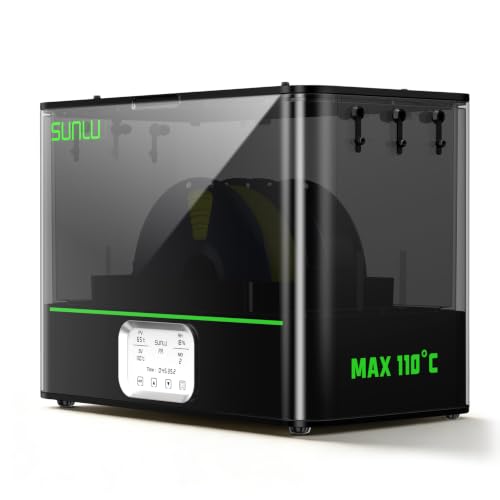
After the temperature gate, check the timer, loading diagram, supported operating mode, airflow or vent instructions, capacity, reel dimensions, and whether the exact model permits the intended print-through arrangement. A 110°C ceiling provides headroom for the two examples above, but it is not permission to select 110°C and does not prove that the loaded reel, arrangement, or material supports it.
- Requirement at or below 80°C: compare exact models that document the complete range, load, and mode.
- Requirement at 90°C: remove 80°C and 85°C models before comparing features.
- Requirement at 100°C: keep only models whose documented adjustable range reaches at least 100°C.
- Unknown grade or reel limit: stop and verify; do not choose from the word nylon alone.
Do not confuse drying with annealing or conditioning
A product page can contain several thermal or moisture procedures. Polymaker’s Fiberon PA6-CF20 page lists drying at 100°C for eight hours when moisture has been absorbed, then separately lists annealing at 80°C for six hours. Substituting the easier-looking 80°C pair would change the operation, not solve an equipment shortfall.
Finished-part conditioning is another distinct step. Keep separate records for feedstock preparation, conditions during printing, annealing, and any post-print moisture conditioning named by the maker. A cleaner surface or reduced stringing does not prove that a structural part has completed every required preparation or post-processing step.
As an Amazon Associate, we earn from qualifying purchases. Buying through our links may earn us a commission.
Comparing equipment? Review the documented limits before buying.
View SUNLU E2 on Amazon ↗A relevant option to investigate, not a diagnosis or a universal recommendation.
Verify the reel before heating the load
The filament process does not establish the carrier’s heat tolerance. Prusa says its redesigned black spool introduced from October 2025 resists drying temperatures up to 90°C. It separately warns that an older black spool can loosen above 45°C unless its documented screw preparation is followed, while the older grey spool is usable up to 90°C. Identify the actual generation rather than applying one brand-wide assumption.
A refill carrier, printed adapter, respool, or replacement reel needs its own supported limit. Also measure the loaded reel’s diameter and width and confirm the permitted loading arrangement. Physical fit, free rotation, required clearances, and heat tolerance are separate checks; passing one does not imply the others.
Plan drying, protected feeding, and storage as one workflow
Complete the exact pre-drying instruction before judging a print. If the material maker requires a protected or heated environment during the job, confirm that the dryer or dry box supports the intended outlet, runtime, and loading arrangement. Beginning a print while a wet spool has only started warming is not the same as completing the documented preparation.
Record the grade, source and check date, reel, equipment, mode, temperature, duration, load, and one repeatable print observation. After the job, return unused material to the storage specified by the maker. If the supported cycle does not change the chosen symptom, investigate printer settings and feed resistance as separate variables rather than escalating heat without evidence.
Use a two-track buying checklist
Track one verifies the material process: exact grade, source, condition, temperature, duration, method, and during-print requirement. Track two verifies the equipment and load: exact model and revision, adjustable range, timer, mode, reel tolerance, dimensions, capacity, and feed path. A shortlist entry survives only when every required fact is supported or clearly marked for confirmation.
Use the high-temperature collection to compare the site’s verified products by documented ceiling, then enter the exact requirement in the Dryer Finder. The Finder screens published temperature, capacity, and entered reel dimensions. It does not certify nylon compatibility, reel heat tolerance, process equivalence, or finished-part performance.
Sources and research notes
This guide synthesizes published guidance. It does not describe our own laboratory or hands-on product testing. Material instructions apply to the named manufacturer and grade.